
Things that have (most horribly!) re-appeared

What is the moral response to so much evil being done in our name? I feel anguished by the news but also paralyzed, wondering what I can do—what I can write. What I can offer.
I’m old enough to remember when the news of the world didn’t seem like an unfolding nightmare every day. When we took for granted the continuing survival of our species, and the habitability of our planet. When it seemed that, although our country made mistakes and sometimes did very bad things, we were mostly a good country, allied with other good countries in the world.
That’s no longer the case! The very best qualities of our country, qualities admired by people around the world—our Bill of Rights, our system of checks and balances, our aspiration toward justice for all—are being eroded before our eyes, and before the eyes of the world, by the Trump administration.
But maybe the evil, greed and corruption that are so on display now have always existed here: maybe they were simply hidden (at least from me, born, as I was, into the intellectual, art-loving, secular Jewish middle class in post-War Los Angeles).
My parents’ friends were all idealists. The anthems of the Civil Rights Movement still choke me up, every time I sing them. I was trained never to cross a picket line. And yet there were no people of color in Crestwood Hills when I was living there, the first time around, from my birth to age nine.
How was it that I didn’t notice? White privilege is a buzzword and a cliche—but it’s also real.
I only found out decades after I left home that there was a restriction clause in the covenant for our neighborhood, a covenant that caused some people with stronger convictions than my parents to take their nest-egg and build a home somewhere else.
I had to find that lesson out on my own. It was confirmed when I brought home my first boyfriend from high school, a brilliant fellow student, a grade above me and one of only two Black students (if I’m remembering correctly) at Pali High, from a family that was infinitely more sophisticated and accomplished than mine. When I walked through the door with him, my mother dropped the open can of Campbell’s tomato soup she was holding, and it splattered onto the floor. My father, who wasn’t living with us by then, insisted, when he heard, that I be brought to see a psychiatrist.
I couldn’t believe their hypocrisy—and I burn with shame at the memory.
David and I wrote each other beautiful letters. Years later, it turned out that he’d saved a poem of mine that had been published in our high school magazine—and sent it to me on Facebook.
We haven’t seen each other in person since that time of innocence, when I was fourteen and he was sixteen—but I’ve held him gratefully in my memory as a beautifully poetic and sweet pre-first boyfriend.
He and I didn’t talk about our families—and why would we have done so? I’d never been to his house and he’d only been that one time to mine. But my memory is often faulty! Was I there once? I remember that he lived next-door to his best friend, in a magnificent house in Pacific Palisades. I have a vague memory of swimming pools surrounded by rocks and streams, looking as if they were part of the natural world.
I had no idea that he was mixed-race or even, at the time, what that meant. His mother was one of the most brilliant pioneering architects of our era, designer of the American Embassy in Tokyo and LAX’s Terminal One. His father, also an architect, was a German Jew who’d survived the Holocaust. I never met his parents. I never knew until this moment (doing a little research) that his parents’ marriage only lasted a few years—or that his amazing mother married as many times as I have now. We never talked of these things. I dearly wish now that I’d known her.
As I wrote in one of my recent poems, “It can take us a lifetime to know what we know.”
Was the world always like this?
It doesn’t seem likely that such a large segment of humankind has suddenly become evil. Horrifying racial injustice and completely outrageous misogyny have always existed. But it seemed that progress was being made in rooting them out, creating legal protections and evolving toward more justice in the world.
Is the arc of the moral universe on a down-swing? If that’s so, can we change course?
The evil-doers are so ridiculously powerful now—so grotesquely wealthy in a way that robs ordinary people of any chance to exercise agency. That creates a world whose rules are made by the mega-wealthy, people addicted to having more and more. People bereft of the moral imperative to be compassionate or generous. People who don’t understand that we have an obligation to share the goodies. People who don’t understand that they are not at the center of everything, and that their needs and desires aren’t inherently more important than anyone else’s.
More scribbles from my journal…
It was all edible (except the plate)
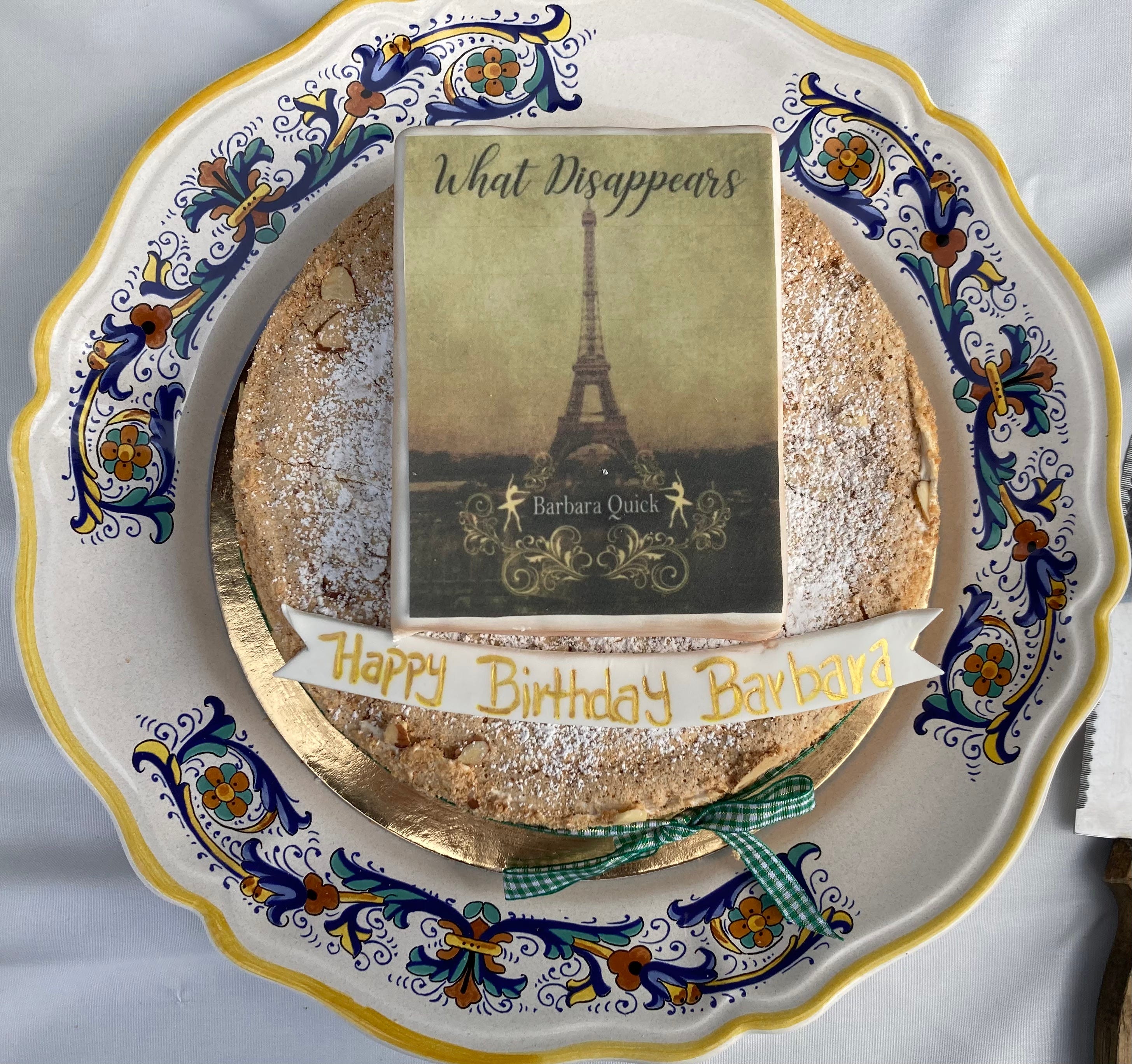
Cake by Gergana of Patisserie Angelica in Sebastopol
I’ve been thinking about the pile of paper in the recycling box whose blank back pages Wayne and I use for shopping lists. Each sheet of paper is a page from my last novel, the next-to-final draft, with a few minor, hand-written corrections. Proof-reading corrections, none of which would be of interest to an archivist (if one were ever to be studying my papers).
Whenever I take another sheet of paper from the pile, I like to read a paragraph or two from the verso side—and remember that I love this novel, and think it’s my best. The craft of it, and the music and emotion of it, make me feel proud, although it was published much less successfully than Vivaldi’s Virgins, its much more famous older sister.
I thought about the shopping lists written on the pages, one by one, as the novel—true to its title—disappears. Page by page, list by list, it’s going back to the trees it came from. Back to the soil where I planted the seeds of it and nurtured the characters as their story revealed itself to me—sometimes in dreams, sometimes here in the pages of my journal—and I wrote and wrote with such a sense of inevitability and joy, and the characters—both the ones from history and the ones I invented to move among them—spoke with one another and revealed their hopes and dreams and disappointments, and filled out the sketches I’d made with the contours of their own fully realized lives, and grew from seedlings into glorious trees.
Arborio rice
toilet paper
distilled water
a good chicken
butternut squash
Consuming the Decoration on My Birthday/Book Launch Cake

First we ate my name, spelled out in gold
on a smooth white ribbon of marzipan.

Then we ate the Paris sky from 1908,
in muted shades of sepia with brassy highlights.

Next, the Eiffel Tower, as if we were giants in a horror film,
crushing the chocolate stanchions between our teeth.

We ate the title of my novel, one syllable at a time,
reading aloud what was left after each piece of that literary cake
was consumed:

What went first—and then Disappears became appears,
till all that remained was pears spelled out atop
a delicious square of gateau parisien.

And suddenly, symbolically, it seemed as if it were I myself
in the process of being consumed, word by hard-won word,
as the world began to read my latest novel,
so many decades in the making.

Sick with all that sugar, I wrapped the final remaining square
(with its misleading label of pears) in waxed paper,
on the kitchen counter, for another day which I knew
couldn’t possibly equal the glory of that afternoon
when I so gladly gave all the words of my story away.


Copyright © 2026 by Barbara Quick
In case you’d like to read What Disappears, this is the best way to buy it.
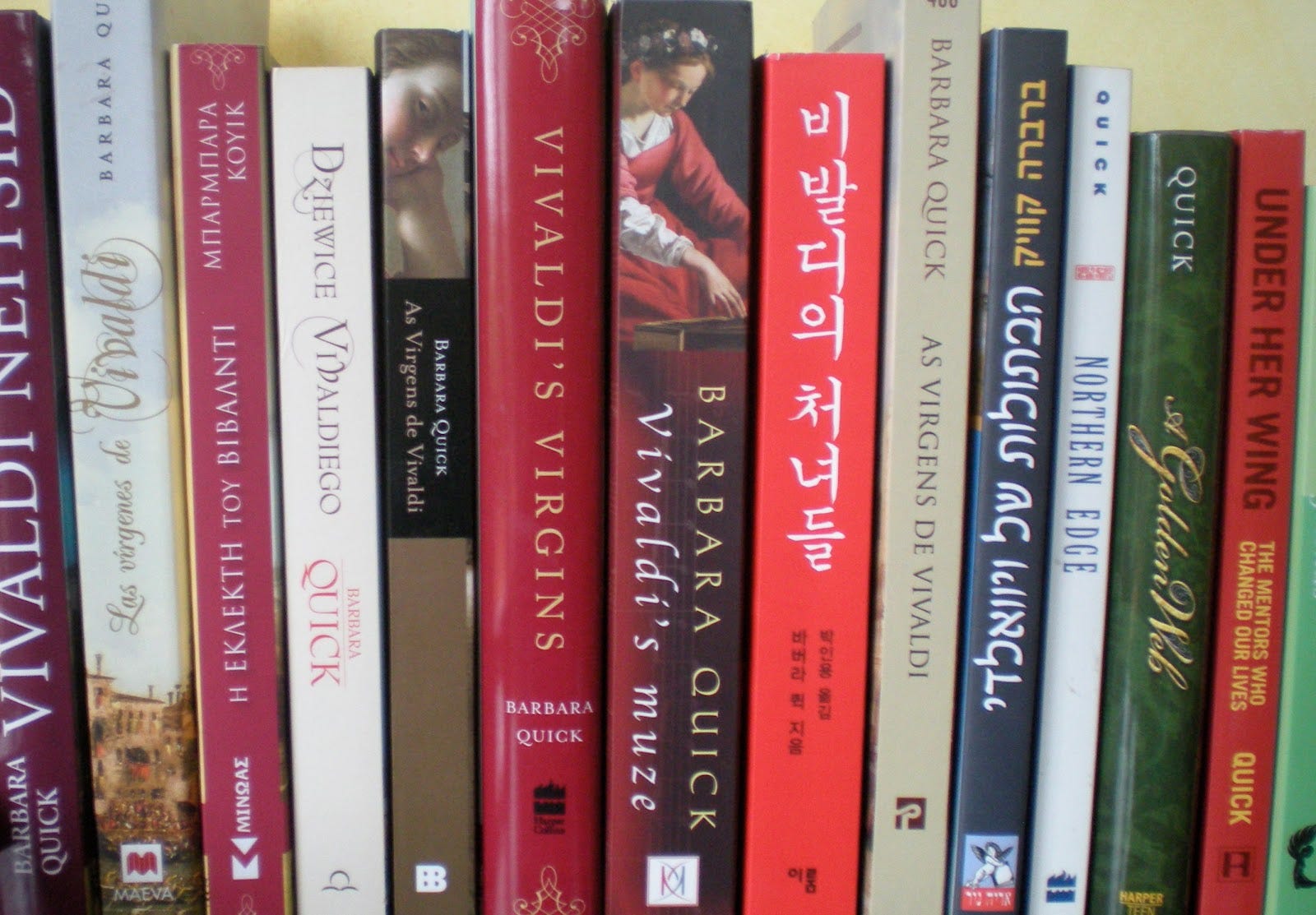
Check out all my novels, as well as my other books, here.
Would you like me to make an author visit to your book club, either virtually or in person?
